Process Sensors
AS7100Sanitary Four-electrode Conductivity Sensor
The AS7100 is a sanitary four-electrode conductivity sensor covering 0.02-500 mS/cm. PEEK insulation, 316L or C22 electrodes and operation to 135°C support CIP concentration monitoring and demanding hygienic processes.
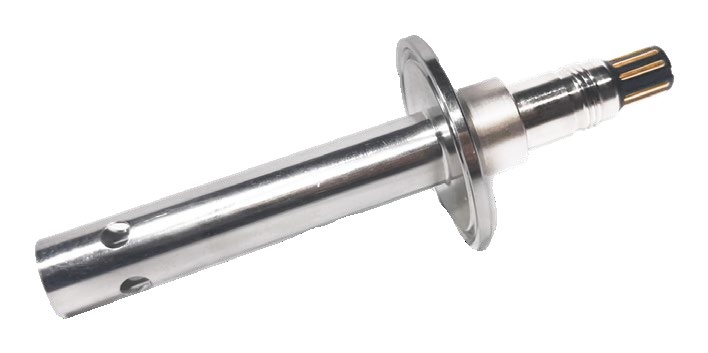
Technical overview
Published configuration data
Values below describe catalog or typical configurations. The confirmed quotation and model code define the supplied specification.
- Range
- 0.02-500 mS/cm
- Temperature
- -20 to 135°C
- Pressure
- 0-6 bar
- Process thread
- PG13.5
- Body
- PEEK
- Electrodes
- 316L or C22
Key characteristics
Why engineers consider AS7100
- Wide four-electrode range
- Sanitary design
- Chemical-resistant materials
- PT1000 temperature element
Typical applications
Where it fits
- 01CIP concentration
- 02Food and beverage
- 03Biopharma skids
- 04Chemical concentration monitoring
Selection checklist
Confirm these conditions before ordering.
Sending this information helps CurioSens verify the measurement principle, materials, range and interface.
- 01Process medium and composition
- 02Minimum, normal and maximum measuring range
- 03Operating and sterilization temperature
- 04Operating pressure and pressure peaks
- 05Pipe or tube size and process connection
- 06Required output, power supply and control interface
Engineer-reviewed FAQ
Questions about AS7100
Application answers reviewed for compatibility, selection, installation and maintenance.
What sensor maintenance factors should be evaluated before purchasing online liquid analyzers?+
Evaluating long-term maintenance costs is vital when choosing liquid analytical sensors. Traditional liquid-filled or gel pH sensors experience electrolyte depletion over time, whereas models like the AS3250 utilize silver ion traps and pressurized reference systems to minimize drift during steam sterilization. Optical dissolved oxygen sensors like the AS6860i eliminate polarographic electrolyte refilling and membrane cap replacements entirely. For conductivity, electrodeless inductive sensors like the AS7250 remove polarization and electrode fouling in dirty fluids. Because maintenance intervals depend on process chemical exposure and CIP cycles, exact maintenance schedules must be confirmed for the selected configuration. Provide your medium, flow range, pressure, temperature, viscosity, tube size, process connection, and required output.
maintenanceWhat measurement range is covered by the AS7100 sanitary four-electrode conductivity sensor?+
Four-electrode conductivity technology overcomes polarization errors inherent in two-pole sensors when measuring medium to high conductivity liquids. The AS7100 sanitary four-electrode sensor provides continuous measurement across 0.02 to 500 mS/cm, making it suitable for pharmaceutical buffer preparation, food processing, and CIP chemical tracking. The sensor body is molded from PEEK with electrode options in 316L stainless steel or Hastelloy C22 for aggressive media. It operates across temperatures from -20°C to 135°C and pressures up to 6 kg (bar), featuring PG13.5 process threads and VP6 connectors with integrated PT1000 temperature elements. Transmitter cell constant scaling must be confirmed for the selected configuration. Provide your medium, flow range, pressure, temperature, viscosity, tube size, process connection, and required output.
selectionHow does a 4-electrode conductivity sensor prevent polarization errors in high-salinity media?+
In two-electrode conductivity sensors like the AS7000, ion accumulation at the electrode interface creates an electrical polarization resistance that acts in series with solution resistance, causing significant measurement underestimation in conductive fluids (>2 mS/cm). Four-electrode sensors like the AS7100 solve this by using two outer electrodes to pass alternating current and two inner voltage electrodes to measure potential drop across the liquid. Because virtually no current flows through the voltage-measuring circuit, contact polarization and surface fouling errors are eliminated. This enables a single 4-electrode sensor to cover wide spans from 0.02 to 500 mS/cm. Temperature compensation slope factors must be confirmed for the selected configuration. Submit your medium, flow range, pressure, temperature, viscosity, tube size, process connection, and required output.
comparisonWhat operating pressure and temperature ratings apply to the AS7100 sanitary conductivity sensor?+
Designed for hygienic applications in biopharmaceuticals and food processing, the AS7100 four-electrode conductivity sensor features a PEEK body with 316L stainless steel or Hastelloy C22 electrodes. It withstands continuous process temperatures from -20°C to 135°C and working pressures up to 6 kg (bar), enabling inline presence during Clean-In-Place (CIP) and Steam-In-Place (SIP) routines without sensor removal. Insertion lengths include 120mm, 225mm, 325mm, and 425mm with PG13.5 process threads and VP6 waterproof connectors. Standard integrated temperature sensing uses a PT1000 element. Elastomer seal ring compatibility for steam exposure must be confirmed for the selected configuration. Send your medium, flow range, pressure, temperature, viscosity, tube size, process connection, and required output.
compatibilityWhat is the difference between contacting 2-electrode, 4-electrode, and inductive conductivity sensors?+
Selecting conductivity technology depends on fluid conductivity and fouling potential. 2-pole contacting sensors like the AS7000 measure current between two stainless steel electrodes, providing maximum precision in ultrapure water lines (0-2000 uS/cm). 4-electrode sensors like the AS7100 use separate drive and sense electrodes to eliminate polarization across medium-to-high ranges (0.02-500 mS/cm) in pharmaceutical buffers. Inductive toroidal sensors like the AS7250 use magnetic coils in a PEEK/PFA torus, measuring highly conductive or dirty liquids (0.05-2000 mS/cm) electrodelessly without surface fouling. Sensor cell constant matching must be confirmed for the selected configuration. Provide your medium, flow range, pressure, temperature, viscosity, tube size, process connection, and required output for recommendation.
comparisonRelated instruments